

Reviewed by a board-certified geriatrician
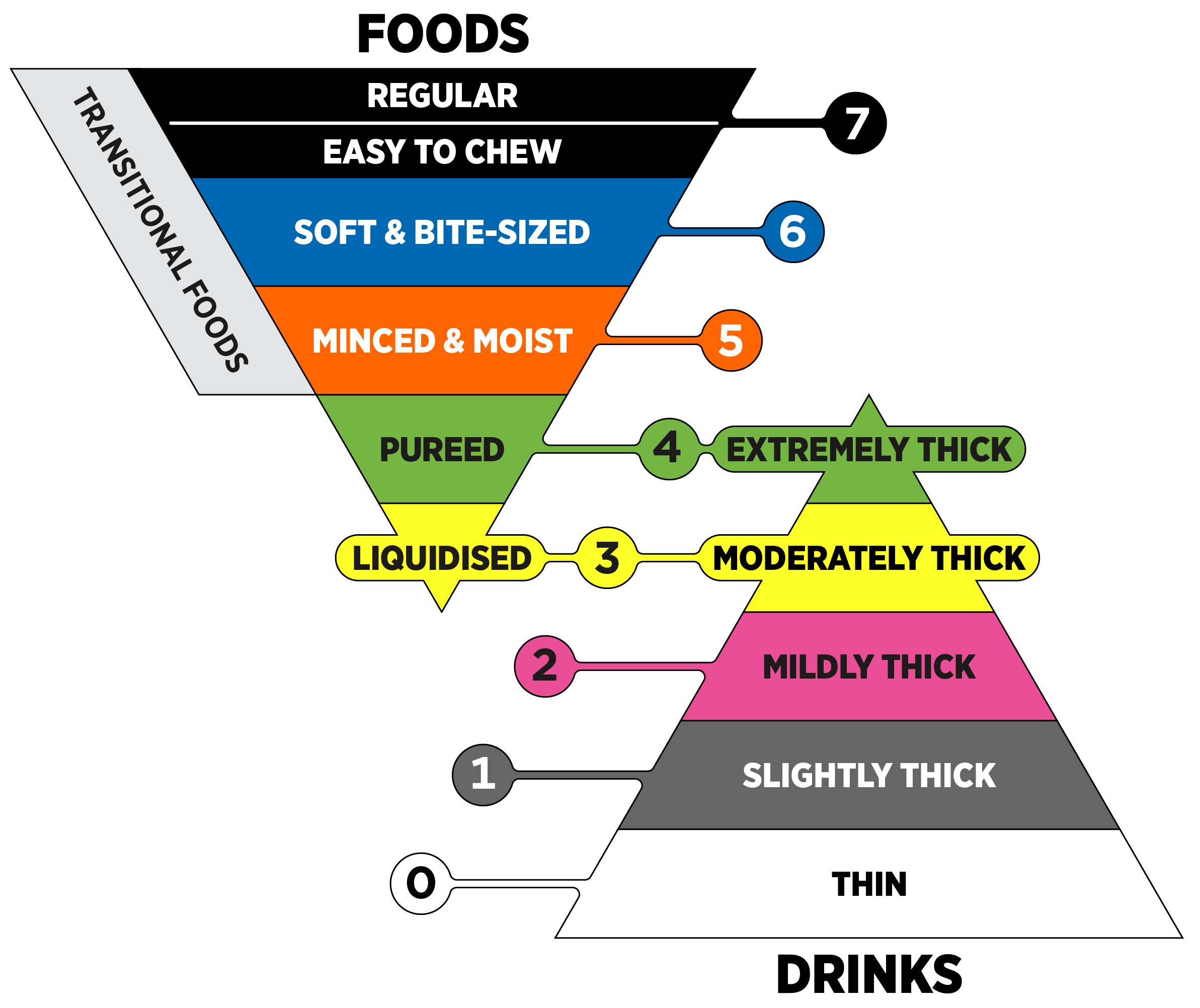
© The International Dysphagia Diet Standardisation Initiative 2019 @ https://iddsi.org/ Licensed under the CreativeCommons Attribution Sharealike 4.0 License https://creativecommons.org/licenses/by-sa/4.0/legalcode. Derivative works extending beyond language translation are NOT PERMITTED.
The short answer: If swallowing has become harder, a speech-language pathologist or doctor may recommend a specific food texture and drink thickness. The IDDSI framework is the international standard for describing these. It uses levels 0 to 7, so everyone, from the hospital to the home kitchen, means the same thing.
Always follow the level recommended for you or your loved one. This guide explains the levels. It doesn't replace a swallowing assessment.
Signs that swallowing may be changing
Coughing or clearing the throat during or after eating or drinking
A wet or gurgly voice after swallowing
Food sticking, or taking much longer to finish meals
Unplanned weight loss, or repeated chest infections or pneumonia
If you notice these, talk with your doctor about a swallowing evaluation.
The levels at a glance
Drinks
Level 0 · Thin: flows like water.
Level 1 · Slightly thick: a little thicker than water.
Level 2 · Mildly thick: flows off a spoon, sippable.
Level 3 · Moderately thick: drinkable from a cup, no straw.
Level 4 · Extremely thick: eaten with a spoon.
Foods
Level 3 · Liquidised: smooth, pours, eaten with a spoon.
Level 4 · Pureed: smooth, holds its shape on a spoon, no lumps.
Level 5 · Minced & Moist: soft, moist, small lumps (adults: no wider than 4 mm).
Level 6 · Soft & Bite-Sized: tender pieces no bigger than 1.5 cm.
Level 7 · Easy to Chew or Regular: soft, tender everyday foods, or regular foods.
There is also a group called transitional foods. These start firm, like certain wafers or melt-in-the-mouth crisps, but quickly soften or melt with moisture.
Simple checks you can do at home
Drinks, flow test: fill a 10 mL syringe, let it run for 10 seconds, and see how much is left. Less than 1 mL is thin (0), 1 to 4 mL is slightly thick (1), 4 to 8 mL is mildly thick (2), and more than 8 mL is moderately thick (3).
Fork pressure test (Levels 5 to 7): press a piece with the back of a fork until your thumbnail turns white. Soft & bite-sized and easy-to-chew foods should squash, break apart and not spring back.
Spoon tilt test (Levels 3 to 5): tip a spoonful. Pureed and minced foods should slide off easily and not stick.
Fork drip test (Levels 3 to 5): pureed food sits in a mound on the fork and doesn't drip through.
Foods to be careful with
Mixed textures (like cereal in milk or soup with chunks), stringy or crumbly foods, hard or dry foods, skins and seeds, sticky foods like mochi or peanut butter, and round foods like grapes are common choking risks for people with swallowing changes.
Tips for meals that are still enjoyable
Season well. Smooth foods can still be full of flavor.
Keep foods separate on the plate, so each one looks and tastes like itself.
Add protein and calories with yogurt, milk, eggs, tofu or nut butter thinned into smooth sauces where safe for the level.
Sit upright for meals and stay upright for at least 30 minutes after.
Find recipes by level
Level 4 · Pureed: smooth with no lumps, holds its shape on a spoon, and needs no chewing. Try the silky sweet potato and coconut puree.
Level 5 · Minced & Moist: soft and moist with small lumps (no wider than 4 mm) that are easy to squash with your tongue. Try the minced salmon with mashed potato and gravy.
Level 6 · Soft & Bite-Sized: tender pieces no bigger than 1.5 cm that mash easily with a fork. Some chewing is needed. Try the tender chicken and vegetable stew.
Level 7 · Easy to Chew: everyday foods that are soft and tender. Avoid hard, chewy, stringy or crunchy foods.
Level 7 · Easy to Chew: adapting the recipes you already have
Sheet-pan salmon: cook the sweet potato and green beans until very soft. Flake the salmon and skip any crispy skin.
Miso soup: use soft tofu and well-cooked greens. If thin liquids are a concern, check with your speech-language pathologist about thickening the broth.
Overnight oats: leave out the nuts and chia seeds, and use ripe banana or papaya.
How Discover Health can help: Dr. Suen can look at weight, nutrition and swallowing as part of a geriatric consultation, and coordinate with a speech-language pathologist. Learn about Geriatric Consultation or call (202) 670-8838.
Source: IDDSI Framework and Detailed Definitions, version 2.2 (April 2026), iddsi.org; IDDSI testing methods. This article is general information, not personal medical advice.